
Robotics-as-a-Service Pricing Guide for Packaging Manufacturers
Understand Robotics-as-a-Service pricing for packaging manufacturers. Compare RaaS against buying automation and learn how to build the business case.
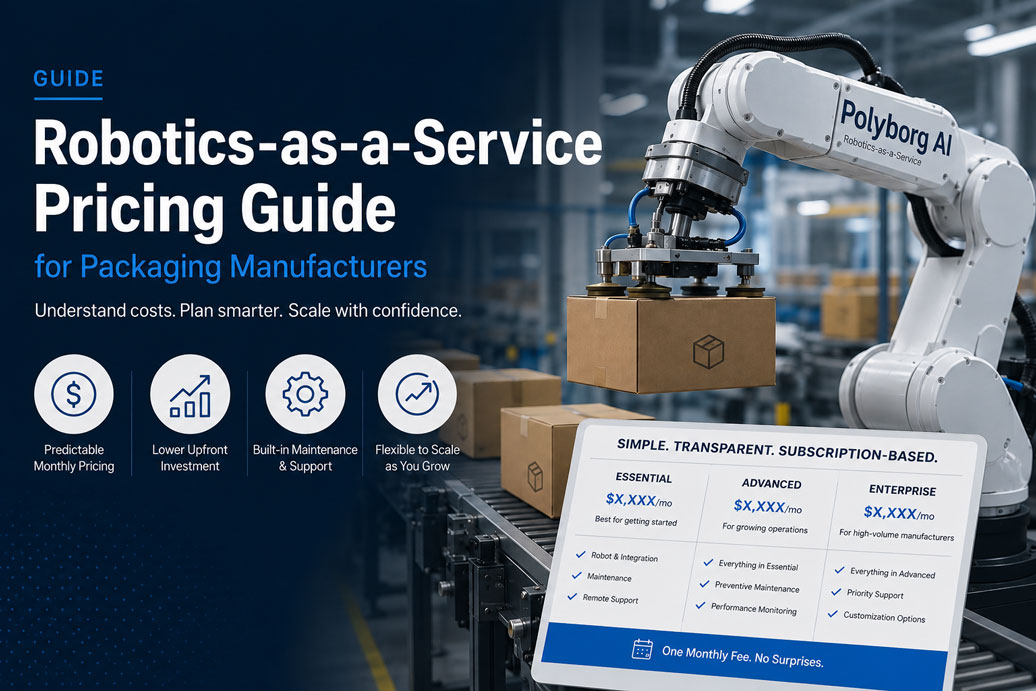
For packaging manufacturers, the automation question is no longer whether robots can help. The harder question is how to pay for automation without slowing production, tying up capital, or adding a support burden the team is not staffed to manage.
That is where Robotics-as-a-Service (RaaS) starts to make practical sense for teams that need reliable throughput, better labor coverage, and faster deployment.
In a conventional project, the manufacturer buys the equipment, pays for integration, owns the maintenance plan, and carries the performance risk. In a RaaS model, the workcell is evaluated as an operating expense tied to capacity, uptime, support, labor reliability, and production outcomes.
What Is Included in Robotics-as-a-Service Pricing?
RaaS pricing should not be compared only against the purchase price of a robot arm. For packaging operations, the better question is: what does it cost to add reliable automated capacity to this line?
| Pricing Component | What It Usually Covers | Why It Matters for Packaging Manufacturers |
|---|---|---|
| Equipment access | Robot, controls, tooling, and supporting hardware | Reduces the need for a large upfront equipment purchase. |
| Deployment and integration | Site assessment, installation, programming, and line setup | Helps ensure the workcell fits the real packaging environment. |
| Maintenance and support | Service, troubleshooting, updates, and performance monitoring | Reduces the internal burden on plant and maintenance teams. |
| Training and onboarding | Operator training and workflow handoff | Helps teams adopt automation without disrupting production. |
| Uptime accountability | Support structure tied to keeping the system productive | Makes pricing easier to compare with labor and downtime costs. |
That is why RaaS often comes up when teams are evaluating manufacturing automation services, not just shopping for equipment. In practice, they are looking for an operating model, not just a machine.
What Affects the Monthly Price of a RaaS Packaging Workcell?
There is no universal monthly price for a RaaS packaging workcell, and that is usually the first point worth clarifying. Pricing is usually shaped by task complexity, required throughput, shift schedule, case weight, package dimensions, pallet patterns, floor space, safety requirements, tooling needs, support expectations, and SKU variability.
A workcell built around robotic palletizers may be priced differently depending on case weight, pallet pattern, line speed, and shift schedule. The same applies to broader packaging automation solutions for palletizing, case handling, shrink-wrapped bundles, or end-of-line material handling.
RaaS vs Buying Automation Equipment
Buying automation equipment can make sense when a manufacturer has available capital, internal engineering resources, stable production requirements, and a long planning horizon.
Many mid-market packaging teams are in a more practical position: they need to add capacity quickly, reduce reliance on hard-to-fill roles, and avoid a large capital project before the operational case is proven.
| Buying Automation | Robotics-as-a-Service |
|---|---|
| Larger upfront capital requirement | Recurring operating expense model |
| Manufacturer owns equipment risk | Provider shares responsibility for deployment and support |
| Internal team manages more maintenance burden | Service and support are built into the model |
| Longer internal approval process may be required | Easier to evaluate against monthly labor and capacity costs |
| Best when requirements are stable and capital is available | Best when speed, flexibility, and support matter |
The point of RaaS is not that it makes automation cheap. It is that automation becomes easier to evaluate and scale when the business case is tied to production capacity rather than equipment ownership.
How to Build the Business Case for RaaS Pricing
The best RaaS business cases usually start with operational inputs, not equipment specs. Packaging leaders should calculate the current cost of the manual task before comparing it with a monthly automation price.
Useful inputs include wages, overtime, turnover, training, operators per shift, missed production, bottleneck costs, throughput targets, scrap, rework, and shipment delays.
An end-of-line palletizing bottleneck may not look expensive if the team only counts hourly wages. It becomes more significant when the analysis includes overtime, ergonomic strain, shift gaps, delayed shipments, and the value of moving operators to higher-value work.
Five Questions a Practical RaaS Evaluation Should Answer
- Which manual task is constraining production?
- How many labor hours are required to cover it?
- What happens when the role is understaffed?
- What throughput or uptime improvement would create measurable value?
- What support is needed to avoid overloading the internal team?
When RaaS Pricing Fits Packaging Manufacturers Best
RaaS tends to fit best when a packaging operation has a clear, recurring task that is difficult to staff or scale, such as palletizing, case handling, line tending, pick-and-place work, material handling, or end-of-line automation.
The model can fit manufacturers that need to add capacity without a long capital cycle, reduce reliance on hard-to-fill roles, improve bottleneck throughput, or support growth without another shift.
RaaS may be less appropriate when a process is highly experimental, changes constantly, lacks production volume, or requires a custom system that cannot be supported economically through a service model.
What Packaging Teams Should Ask Before Requesting Pricing
Before requesting RaaS pricing, packaging manufacturers should prepare the details needed for a practical recommendation: product type, package dimensions, case weights, throughput, shift schedule, floor space, labor coverage, changeover frequency, and target pain point.
Teams should also ask what is included, how support works, what happens during downtime, what internal resources are required, and how success is measured.
Conclusion
For packaging manufacturers, Robotics-as-a-Service pricing should be evaluated as a capacity and labor reliability model, not simply as another way to finance equipment.
The comparison should not stop at robot price versus monthly fee. The right comparison is the cost of manual work, overtime, downtime, staffing instability, and lost throughput versus the cost of a supported automation workcell.
Polyborg AI helps packaging manufacturers evaluate whether RaaS is the right fit for their line, labor constraints, and production goals. If your team is evaluating palletizing, end-of-line automation, or packaging line support, the next step is to quantify the operational baseline and compare it with a service-based automation model.
See pricing for your packaging line or get in touch with Polyborg AI.
FAQ
Frequently asked questions
- How is Robotics-as-a-Service different from leasing a robot?
- Leasing usually finances equipment. Robotics-as-a-Service typically includes deployment, support, maintenance, monitoring, and performance accountability.
- Is RaaS only for large manufacturers?
- No. RaaS can fit mid-market packaging manufacturers with clear production pain points and a limited appetite for a large upfront purchase.
- What packaging tasks are best suited for RaaS?
- Good fits include palletizing, case handling, end-of-line material handling, line tending, and repetitive pick-and-place work with measurable volume.
- What information is needed to get accurate RaaS pricing?
- Teams should prepare product details, package dimensions, case weights, throughput needs, shift schedule, floor-space constraints, labor coverage, and the target bottleneck.
- Does RaaS replace internal maintenance teams?
- Not entirely. RaaS can reduce the support burden, but internal teams may still help with line access, operator feedback, and production communication.