
How to Integrate Automated Palletizer Systems Into Existing Packaging Lines
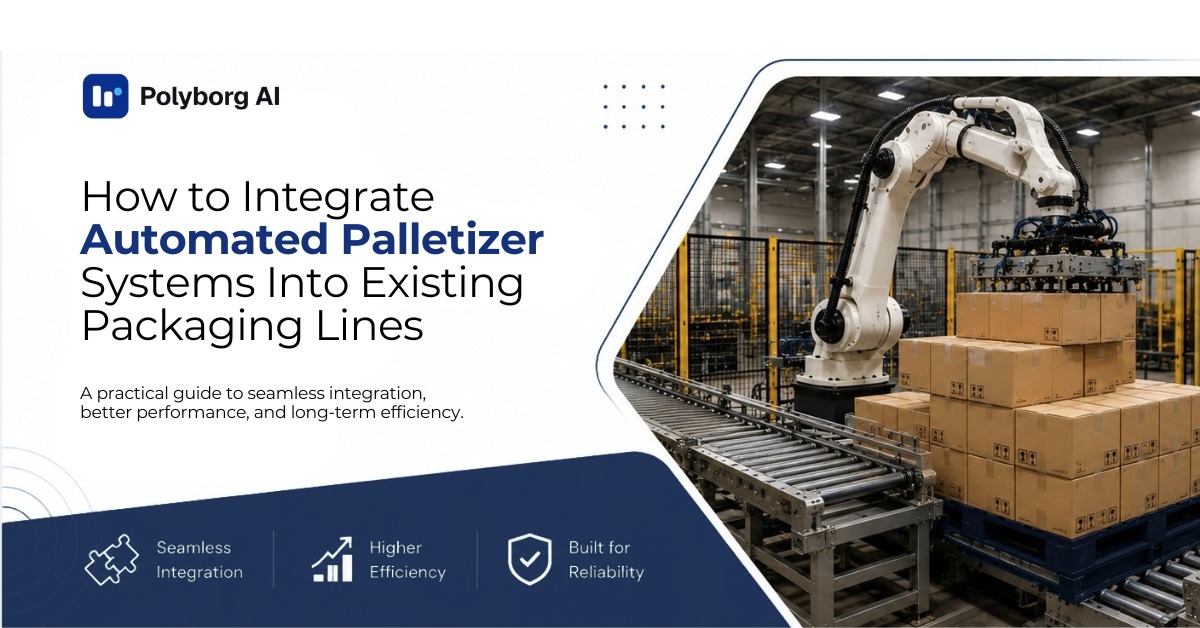
Most conversations about packaging automation start with the robot. The speed, the payload, the end-of-arm tooling. But if you talk to any operations manager who has actually put a robot on the floor, they will tell you the robot is only part of the story.
The real work is in the integration, and when it is done right, the results are significant, both operationally and financially.
Dropping an automated palletizer at the end of a packaging line is not a plug-and-play exercise. Most mid-market manufacturing facilities were not originally designed with robotics in mind. Floor space is tight, upstream conveyors have their quirks, and product flow varies by shift. Planning for how the robot interacts with the rest of the line, and how it will be paid for, is what separates a smooth deployment from a slow one.
Here is what it actually takes to integrate a palletizing system into an existing packaging environment, what that integration typically costs under each financing model, and how to set it up for long-term performance.
What Integration Actually Costs
Before mapping the floor plan, it helps to know the real cost range for an integration project, because it shapes how much internal engineering time to budget and whether a subscription model removes that burden entirely.
- Equipment and hardware: the robot, end-of-arm tooling, vision and sensing, and safety devices typically make up 50-75% of the upfront cost of a purchased system.
- Integration and engineering: infeed metering, squaring mechanisms, safety-circuit tie-ins, and network setup add engineering hours from your team and the integrator, commonly 50-500 hours, or roughly $7,500-$30,000, on top of the hardware.
- Total installed cost: a fully integrated palletizing workcell, hardware plus engineering, typically lands between $100,000 and $250,000 for a purchased system.
- Ongoing upkeep: budget 5-10% of the project cost per year for maintenance, and $2,000-$20,000 per occurrence for unplanned repairs such as motors, bearings, or pendants.
Under a RaaS model, most or all of this is bundled into a flat monthly fee. Polyborg's palletizing tier is $3,599 per month, including installation, 24/7 support, and a 99.3% uptime SLA. That removes the $7,500-$30,000 integration budget and the annual maintenance line item from the plant's capital planning, in exchange for an ongoing operating expense.
1. Mapping the Physical Footprint and Safety Zones
Getting the physical layout right from the start saves a significant amount of rework later. When a vendor presents a CAD drawing of a robotic palletizer, the cell often looks compact. In practice, the full footprint includes safety infrastructure, hard guarding, light curtains, or safety scanners, as well as the access gates and forklift clearance needed to safely remove full pallets. Once all of that is accounted for, the actual floor space required is larger than the robot itself.
If floor space is a genuine constraint, there are practical options. Collaborative robots (cobots) require less guarding and work well in tighter environments. Pre-engineered, modular cells that integrate safety scanners directly into a compact frame are another strong option for facilities where every square foot matters.
A useful step before finalising the layout is to physically tape out the proposed cell on the floor, including the forklift path. It takes twenty minutes and confirms whether the design works in your actual environment before any hardware is ordered.
2. Preparing the Upstream Conveyor Infeed
A robot performs best when the product arrives consistently, same orientation, same spacing, same speed, every cycle.
Most existing packaging lines deliver product with some variation. Cases may skew slightly on older belts, or backpressure from downstream can cause irregular gaps. Addressing this upstream is a standard part of a well-planned integration.
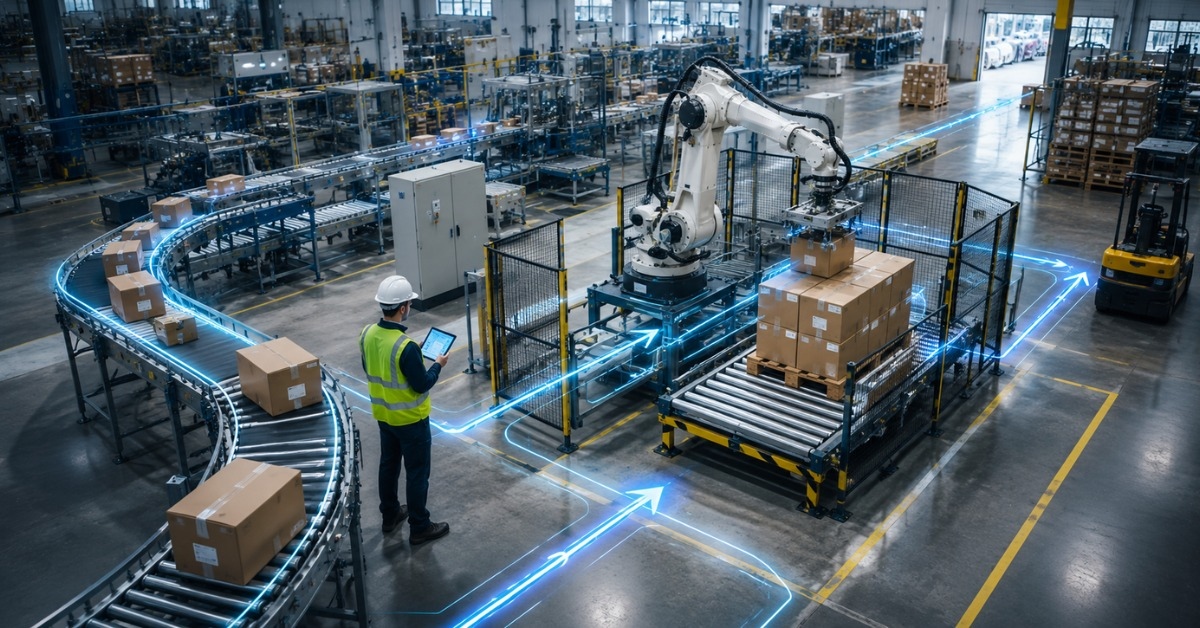
The last section of conveyor feeding the palletizer typically benefits from metering belts to create consistent case spacing and squaring mechanisms to ensure each box arrives in the correct orientation before the robot picks it. Treating the infeed as part of the packaging automation solution, rather than a separate project, is what allows the system to hit its target cycle times reliably from day one.
3. Handling SKU Changeovers
For manufacturers running multiple product formats, changeover flexibility is as important as raw speed.
When the line shifts from a 12-pack of bottles to a 24-pack of cans, the palletizer needs to adapt. Modern systems handle this well. Operators can select new pallet patterns from a touchscreen without writing code, and flexible end-of-arm tooling handles a range of case sizes without manual tool changes.
Building changeover into the operator workflow from the start, rather than treating it as an afterthought, is what makes a high-mix facility run smoothly. The right system makes this straightforward for line workers to manage independently.
4. Network and Data Integration
A palletizer operates as part of the broader line, not in isolation. At a minimum, it needs to be integrated into the line's safety circuit so that an E-stop on the case packer also stops the palletizer. Beyond that, connecting the system to the plant network enables real-time performance monitoring and predictive maintenance.
For manufacturers using a Robotics-as-a-Service (RaaS) model, the system typically requires a secure outbound connection to allow the provider to monitor uptime and respond proactively to any performance changes. Involving the IT team early in the process makes this straightforward and ensures the cell is networked securely without any impact on the broader plant infrastructure.
If you are evaluating which RaaS provider is best suited to manage this kind of ongoing support, our guide on How to Evaluate RaaS Automation Providers covers the right questions to ask.
5. Preparing the Plant Floor Team
The final piece of a successful integration is the people.
When manual palletizing is replaced by a robot, the operator's role shifts from physical labour to system management. Operators need to be comfortable interacting with the HMI, selecting pallet patterns, and responding to routine alerts. This is a straightforward transition with the right training, and most operators adapt quickly.
The most effective deployments include a period where the provider's technicians work alongside the plant team during the first production runs. This hands-on approach builds confidence quickly and ensures the team is self-sufficient from early on.
Our Automated Palletizer Cost Breakdown covers purchase, lease, and subscription options for a detailed look at the financial models available for this kind of deployment.
Buying vs. Subscribing for This Kind of Deployment
Whether integration is worth doing as a capital project or a subscription usually comes down to how long the line configuration will stay the same and how much internal engineering bandwidth is available.
| Factor | Buy & Integrate | RaaS Subscription |
|---|---|---|
| Total installed cost | $100,000-$250,000+ | $0 upfront |
| Integration engineering | 50-500 hrs / $7,500-$30,000, owned by plant + integrator | Included in the monthly fee |
| Annual maintenance | 5-10% of project cost, budgeted separately | Included |
| Typical monthly cost | N/A (capital purchase) | From $3,599/month for a standard palletizing tier |
| Best suited to | A fixed process expected to run 10+ years unchanged | Manufacturers seeking faster deployment, lower upfront costs and predictable operating expenses |
The Bottom Line
Integrating an automated palletizer into an existing packaging line is a practical, well-understood process when approached systematically. The robot, the infeed, the safety layout, the software, and the team all need to work together, and when they do, the performance gains are consistent and measurable.
Get a Palletizing Integration Assessment
If you want to understand how a palletizing system would fit into your specific facility, reach out to Polyborg AI for a site assessment and a realistic deployment plan.
FAQ
Frequently asked questions
- What is an automated palletizer?
- An automated palletizer is a robotic system that automatically stacks boxes, cartons, bags, or products onto pallets in organized patterns. It improves production speed, reduces manual labor, enhances workplace safety, and delivers consistent pallet quality for manufacturing and packaging operations.
- Can an automated palletizer be integrated into an existing packaging line?
- Yes. Most modern automated palletizers are designed to integrate with existing packaging lines. With proper planning, they connect seamlessly to conveyors, case packers, safety systems, and production equipment while minimizing downtime during installation.
- What should manufacturers consider before installing an automated palletizer?
- Before installing an automated palletizer, manufacturers should evaluate available floor space, conveyor layout, safety requirements, product flow, SKU variations, network connectivity, operator training, future expansion plans, and the total installed cost, typically $100,000-$250,000 to buy, versus a monthly subscription starting around $3,599 through a RaaS provider.
- How does an automated palletizer improve packaging line efficiency?
- An automated palletizer increases throughput, reduces manual handling, improves stacking accuracy, minimizes product damage, lowers labor costs, and ensures consistent end-of-line operations, helping manufacturers achieve greater productivity and operational efficiency.
- How much space does an automated palletizer require?
- The footprint depends on the robot, pallet positions, conveyor layout, safety barriers, and forklift access. Compact and modular automated palletizer solutions are available for facilities with limited floor space.