
How to Evaluate RaaS Automation Providers: What Packaging Manufacturers Should Ask Before Signing
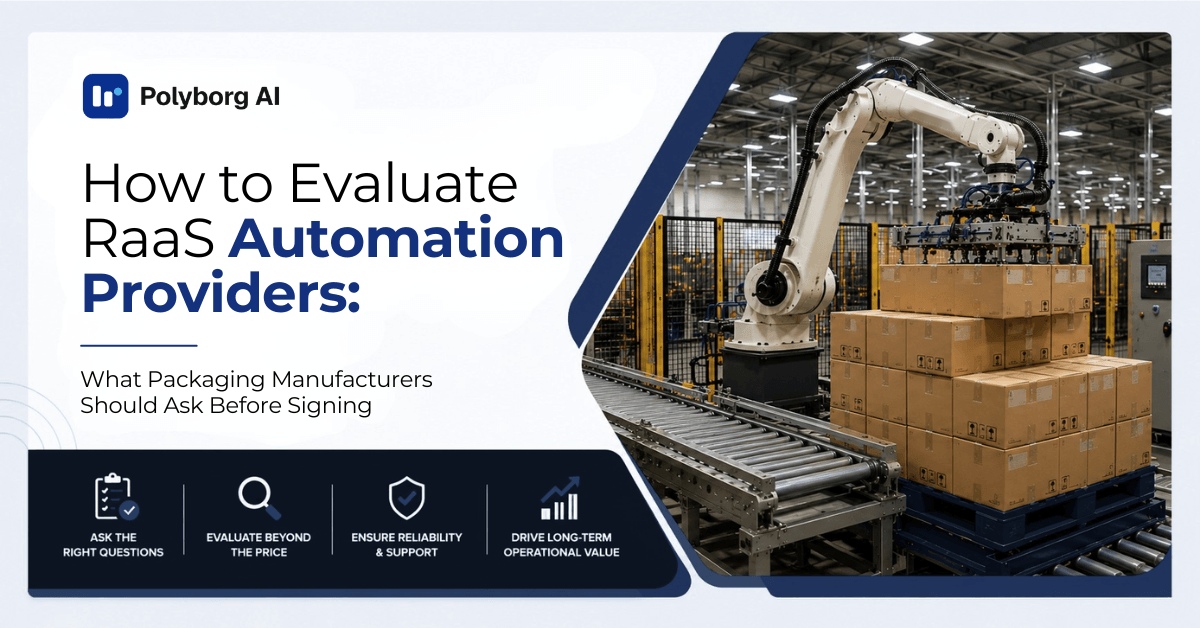
The first time you sit across from a Robotics-as-a-Service (RaaS) provider, the pitch usually sounds straightforward.
No upfront capital. Fast deployment. Maintenance included.
For manufacturers looking to automate palletizing, case packing, or pick-and-place operations, that's an attractive proposition. But once you begin comparing providers, you'll quickly realise that not every RaaS offering delivers the same value.
Some providers build, deploy, and support their own robotic systems. Others simply finance equipment while outsourcing engineering and maintenance to third-party integrators. Some include software updates, spare parts, and preventive maintenance in the monthly fee, while others charge separately.
Choosing the right provider is about more than comparing subscription prices. It's about understanding who will be responsible for your production line over the next three to five years.
This guide outlines the questions experienced operations managers ask before signing a Robotics-as-a-Service agreement.
Understand the Total Cost - Not Just the Monthly Fee
One of the biggest mistakes manufacturers make is comparing providers based only on monthly subscription pricing.
A conventional robotic palletizing project typically requires an upfront investment of $120,000-$350,000, depending on the robot, safety systems, conveyors, integration complexity, and software requirements.
By comparison, many RaaS providers offer palletizing solutions starting from approximately $3,500-$5,000 per month, allowing manufacturers to automate without a significant capital investment.
However, monthly pricing doesn't always include the same services.
Some providers include: installation and commissioning, preventive maintenance, software updates, remote monitoring, technical support, spare parts.
Others charge separately for engineering changes, replacement components, additional SKU programming, or emergency service visits.
Before comparing pricing, ask for a complete breakdown of what's included.
Compare More Than the Monthly Price
When evaluating providers, compare the complete commercial offering rather than the advertised subscription fee.
| Evaluation Criteria | Traditional Automation Purchase | Robotics-as-a-Service |
|---|---|---|
| Initial investment | $120,000-$350,000+ | Typically no upfront capital |
| Monthly operating cost | Maintenance budget managed internally | Subscription from approximately $3,500/month depending on application |
| Maintenance | Managed by manufacturer | Usually included |
| Software upgrades | Often additional cost | Frequently included |
| Spare parts | Purchased separately | May be included depending on provider |
| Deployment speed | 6-12 months for custom projects | Often deployed within weeks for standard applications |
The objective isn't simply finding the lowest monthly payment, it's understanding which provider offers the lowest total cost of ownership throughout the agreement.
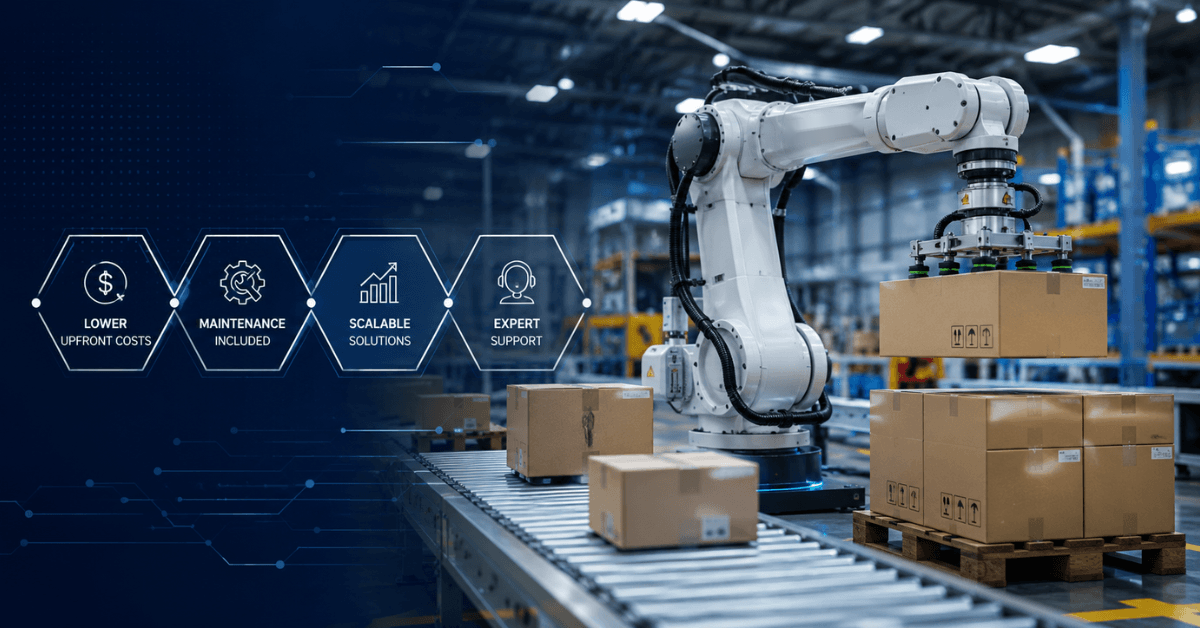
Who Owns the Engineering and the Accountability?
Not every RaaS company designs and builds its own automation systems.
Some providers finance robotic equipment while partnering with independent system integrators for engineering and installation.
Others manage the complete project internally, including mechanical design, robot programming, vision systems, installation, commissioning, and ongoing support.
Ask directly: Do you build your own workcells? Who installs the equipment? Who supports the system after commissioning? If throughput targets aren't achieved, who is responsible?
A provider that owns the engineering process usually provides clearer accountability and faster issue resolution.
Does Their Software Actually Handle Your Line?
Most packaging lines involve real-world variation, cases that shift slightly, labels that reflect light, and pallet patterns that change between SKUs. A robotic system is only as good as the software and vision stack guiding it, and purpose-built vision systems handle real packaging environments significantly better than general-purpose alternatives.
This is especially relevant for manufacturers running beauty, nutraceutical, or food products, anything with reflective surfaces, irregular shapes, or frequent changeovers.
Ask how their system handles reflective packaging. Ask how long a SKU changeover actually takes, and whether your operators can manage it themselves or whether it requires a technician. Ask what happens when a new product format is introduced mid-contract.
The answers will tell you quickly whether you are looking at a purpose-built packaging automation solution or a general-purpose robot with a subscription price tag.
What Does "Support Included" Actually Mean?
Every RaaS provider includes support. The question worth asking is what that looks like in practice.
There is a meaningful difference between a reactive help desk and a provider monitoring your system around the clock, catching performance changes before they affect output. For a plant running two or three shifts, proactive monitoring is what keeps throughput consistent.
Ask for the specifics. Is monitoring 24/7 or business hours only? What is the guaranteed response time for a critical fault? Are spare parts included or billed separately? Is there a formal uptime SLA, and what are the commitments if targets are not met?
If you want to understand how support obligations typically factor into the monthly cost, the Robotics-as-a-Service Pricing Guide for Packaging Manufacturers covers that in detail.
How Long Does Deployment Actually Take?
One of the main reasons manufacturers choose RaaS over a traditional CapEx project is speed. A custom integration can take six to twelve months from purchase order to go-live, whereas a RaaS provider with pre-engineered, standardised workcells for common end-of-line tasks, robotic palletizing, case packing, pick and place, should be able to deploy in weeks.
Asking for the provider's average deployment timeline and how much line downtime is required during installation gives a clear picture of how quickly the system will be generating value. It is also worth confirming whether they test the system with your specific product before it arrives on site.
For more on what to prepare before a deployment, the Automated Palletizer Cost Breakdown covers some of the operational planning considerations worth reviewing.
Can They Scale Beyond the First Workcell?
A single pilot is a reasonable way to prove the model. But if it works, you will want to expand, to additional lines, shifts, or facilities. Scaling requires more than deploying another robot. It requires centralised software visibility, consistent SLAs across sites, and a support infrastructure that grows with the fleet.
Ask whether they provide a centralised dashboard for monitoring multiple systems. Ask how hardware and software upgrades are handled over the life of the contract. Ask whether the pricing model remains predictable as you add workcells.
Procurement Checklist Before Signing
Before committing to a Robotics-as-a-Service provider, make sure you can answer "Yes" to the following questions:
- Is the monthly subscription fully transparent?
- Are installation and commissioning included?
- Does the provider own the engineering process?
- Is preventive maintenance included?
- Are software updates covered?
- Are spare parts included?
- Is there a guaranteed response time?
- Can the system support future SKU changes?
- Can the provider demonstrate experience within the packaging industry?
- Are customer references available?
If several answers are unclear, continue evaluating providers before signing.
Conclusion
Choosing a RaaS provider is not like buying a piece of equipment. It is a long-term operational relationship, and the quality of that relationship will show up in your production numbers every week.
The right provider takes full ownership of the engineering, the software, and the ongoing performance of the system. They monitor proactively, respond quickly, and treat your throughput targets as a shared goal.
Talk to a Team That Owns Its Own Engineering
If you want to have that conversation with a team that builds and operates its own systems, get in touch with Polyborg AI to start with a site assessment.
FAQ
Frequently asked questions
- What is a RaaS automation provider?
- A RaaS (Robotics-as-a-Service) automation provider delivers robotic automation through a subscription model instead of requiring businesses to purchase equipment outright. The provider typically supplies the robots, software, installation, maintenance, monitoring, and ongoing support for a predictable monthly fee.
- What should manufacturers compare when evaluating RaaS providers?
- Compare engineering capability, deployment experience, maintenance coverage, software support, response times, scalability, customer references, and the total services included in the monthly subscription, not just the advertised price.
- What industries benefit most from RaaS automation?
- RaaS solutions are widely used across food and beverage, consumer packaged goods, nutraceuticals, pharmaceuticals, cosmetics and beauty products, logistics and warehousing, and manufacturing, industries that often require flexible automation capable of handling changing products and production demands.
- What questions should I ask before signing a RaaS agreement?
- Ask who owns the engineering, what's included in the subscription, whether software updates and spare parts are covered, what response times are guaranteed, and how the solution can scale as production grows.
- Why choose Polyborg AI for packaging automation?
- Polyborg AI specializes in AI-powered Robotics-as-a-Service solutions designed specifically for packaging manufacturers. From robotic palletizing and case packing to intelligent pick-and-place automation, Polyborg AI provides end-to-end engineering, deployment, software integration, proactive monitoring, and ongoing support to help manufacturers improve operational efficiency while reducing automation costs.