
Robotics-as-a-Service for Manufacturers: The Operational Buyer's Guide
For operations managers and plant leaders, the automation question is rarely abstract. It usually begins with a specific challenge: a palletizing line that cannot keep up with production, a growing labour shortage, rising overtime costs, or increasing demand that existing equipment simply cannot handle.
Robotics-as-a-Service (RaaS) has emerged as an attractive alternative to traditional automation because it allows manufacturers to deploy industrial robots through a predictable monthly subscription instead of a large upfront capital investment. However, choosing a RaaS provider involves much more than comparing monthly pricing.
This guide focuses on the operational side of Robotics-as-a-Service for manufacturers - what to assess before committing, how to compare buying versus subscribing, what to expect during deployment, and how to ensure the investment delivers long-term operational value.
What Does Robotics-as-a-Service Actually Cost?
One of the first questions manufacturers ask is, "How much will automation cost?"
The answer depends on whether you purchase the equipment outright or deploy it through a subscription model.
A typical robotic palletizing, case packing, or pick-and-place workcell purchased through a traditional capital expenditure (CapEx) project generally costs between $180,000 and $350,000. The total investment usually includes the industrial robot, end-of-arm tooling, conveyor integration, safety guarding, PLC programming, vision systems where required, installation and commissioning, and operator training.
For larger, custom-engineered systems, costs can exceed $500,000.
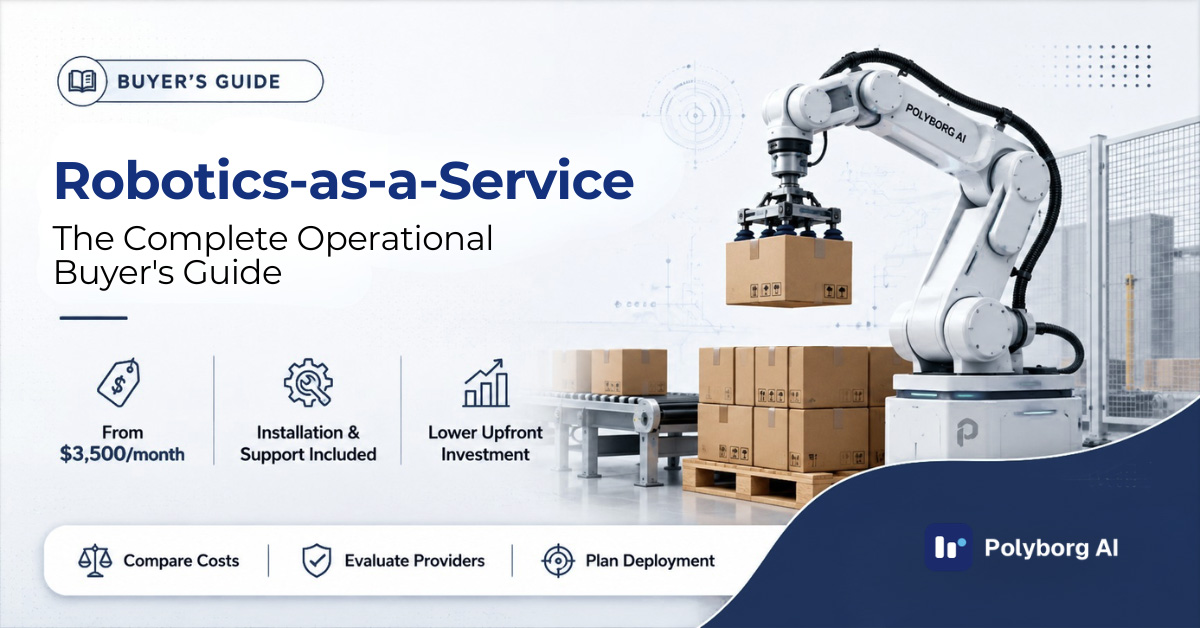
With a Robotics-as-a-Service model, manufacturers can often deploy similar automation from approximately $3,500 per month for standard end-of-line applications. Higher-speed systems or multi-robot workcells will typically command higher monthly subscriptions.
A typical RaaS agreement often includes robot hardware, installation and commissioning, preventive maintenance, software updates, remote monitoring, technical support, spare parts, and performance optimisation.
Instead of committing hundreds of thousands of dollars upfront, manufacturers convert automation into a predictable operating expense while reducing maintenance risk.
Buying vs. Robotics-as-a-Service
Choosing between purchasing automation and subscribing to a Robotics-as-a-Service model depends on your operational priorities.
| Traditional Purchase | Robotics-as-a-Service |
|---|---|
| Upfront investment of approximately $180,000-$350,000 | Monthly subscription starting from approximately $3,500 |
| Company owns equipment | Provider owns equipment |
| Maintenance managed internally | Maintenance included |
| Spare parts purchased separately | Spare parts generally included |
| Software upgrades may require additional investment | Software updates included |
| Larger capital commitment | Lower upfront investment |
| Procurement often takes several months | Faster deployment for standard workcells |
For manufacturers preserving capital for expansion or new production lines, RaaS often provides greater financial flexibility while accelerating automation projects.
The Questions Most Manufacturers Ask Too Late
Most early conversations about RaaS focus on cost: what is the monthly fee, how does it compare to buying, and what is the payback period. Those are reasonable starting points.
The Robotics-as-a-Service Pricing Guide for Packaging Manufacturers covers the cost side in detail. But pricing alone does not determine whether a deployment actually works.
The more valuable questions are operational. Can the plant absorb a new automated workcell while keeping the rest of the line running smoothly? Is the target process stable enough to automate reliably? Who on the plant side owns the day-to-day relationship with the provider once the system is running? Answering these questions before signing puts the plant team in a much stronger position from day one.
Reading the Operational Signals
Before evaluating providers, operations leaders should look at what the plant is already telling them. Certain patterns consistently signal readiness for a service-based automation model.
A line where supervisors routinely reassign operators mid-shift to cover end-of-line tasks is a strong indicator. So is a process where throughput targets are not being met because there are not enough people to keep the line moving. If a plant manager can point to a specific task and say "this is where we lose time every single shift," that is the constraint worth automating first.
Process stability matters equally. A task that runs the same product format at a consistent rate with predictable case dimensions is straightforward to automate and fast to validate. The more defined the process, the faster a deployment can be handed over to the plant team.
Addressing any upstream variability before deployment means the workcell hits its targets from the first production run. A service model also benefits from a clear plant-side point of contact who can give the provider the operational context they need to keep performance consistent.
Evaluating Robotics-as-a-Service (RaaS): The Operational Checklist
When evaluating manufacturing automation services, operations teams should look beyond payload and reach to how the system integrates into daily plant life.
1. Defining the Constraint. Before talking to a provider, define the exact problem: throughput, labour availability, or ergonomic load on the team. Gather baseline data: current cases or pallets per shift, number of operators assigned, available floor space.
2. Understanding the Support Model. A key operational question is how the system is supported once it is running. Who monitors the system? A strong RaaS provider includes 24/7 remote monitoring to catch performance changes early. What is the response time? Understand the Service Level Agreement (SLA) and how quickly a technician can be on site if needed. Who handles preventative maintenance? Confirm the provider manages routine maintenance on a schedule that works around production.
3. Assessing Internal Readiness. RaaS significantly reduces the technical burden on the plant team, and a small amount of preparation makes the transition even smoother. Operator handoff: floor staff benefit from knowing how to interact with the HMI and communicate with the provider's support team. Most operators are comfortable with this within a few shifts. Upstream consistency: a robotic workcell performs best with consistent input. Ensuring upstream conveyors are running reliably before deployment allows the system to reach its target throughput quickly.
What the Plant Team Is Actually Responsible For
A common question about RaaS is how responsibilities are divided once the system is installed. In practice, both sides carry specific obligations, and the clearest deployments are those where this is agreed upfront.
The provider owns the equipment, manages scheduled maintenance, monitors performance remotely, and responds to technical faults. The plant team is responsible for consistent input, properly formed cases, reliable upstream flow, and a clear path for the robot to operate, and is the first line of communication when something changes on the line.
| Responsibility Area | Provider | Plant Team |
|---|---|---|
| Equipment ownership and maintenance | Owns and maintains the workcell. | Provides access and communicates production changes. |
| Remote monitoring and fault response | Monitors system and responds to technical issues. | Clears basic operator-level faults and escalates as needed. |
| Upstream process consistency | Manages workcell performance. | Responsible for case quality, flow, and line readiness. |
| Performance communication | Tracks uptime and output data. | Reports operational context that data alone cannot capture. |
The clearest deployments are those where both sides understand their responsibilities from the start and communicate openly as the line evolves.
Getting the Most From an Automated Material Handling Deployment
The deployments that deliver the strongest results share a few common characteristics.
Start with a stable, well-defined process. The clearer the task, the faster the system can be validated and handed over to the plant team.
Involve the operators early. The people working alongside the robot are its best advocates. Bringing them into the process from the start builds confidence and speeds up adoption.
Define success beyond speed. A system running consistently at a steady throughput with no staffing dependency is often more valuable than a manual line requiring constant management attention.
The Next Step for Operations Leaders
Robotics-as-a-Service is changing how manufacturers invest in automation.
Instead of committing $180,000-$350,000 upfront for a robotic workcell, manufacturers can often begin automating critical packaging operations from approximately $3,500 per month, with installation, maintenance, software updates, and ongoing support included.
However, choosing the right provider requires more than comparing monthly pricing. Manufacturers should evaluate deployment experience, support capabilities, response times, operational expertise, and the provider's ability to scale as production grows.
If you're considering Robotics-as-a-Service for your packaging operation, Polyborg AI can assess your current production line, estimate deployment costs, compare ownership versus subscription models, and recommend the most practical automation strategy for your facility.
FAQ
Frequently asked questions
- What is Robotics-as-a-Service for Manufacturers?
- Robotics-as-a-Service for Manufacturers (RaaS) is a subscription-based automation model that allows businesses to deploy industrial robots without making a large upfront capital investment.
- How much does Robotics-as-a-Service cost?
- For standard packaging automation applications such as robotic palletizing or case packing, subscriptions often start from approximately $3,500 per month. Pricing varies depending on robot type, throughput requirements, integration complexity, and the level of support included.
- How does RaaS compare with buying industrial robots?
- Purchasing a robotic workcell generally requires an upfront investment of $180,000-$350,000 or more, plus ongoing maintenance and upgrade costs. RaaS converts these costs into a monthly operating expense while including maintenance, monitoring, and software updates.
- Is RaaS a good fit for small and mid-sized manufacturers?
- Yes. RaaS can be especially valuable for small and mid-sized manufacturers because it lowers the barrier to automation by reducing upfront capital requirements and providing access to ongoing technical support that smaller plants may not have in-house.
- Does Robotics-as-a-Service include maintenance and support?
- Yes. Most Robotics-as-a-Service providers include preventive maintenance, software updates, remote diagnostics, system monitoring, technical support, and repair services as part of the monthly subscription.