
Packaging Automation Without CapEx: How to Add Capacity Without Buying Equipment
Learn how packaging automation without CapEx helps manufacturers increase capacity, reduce labor pressure, and deploy automation faster.
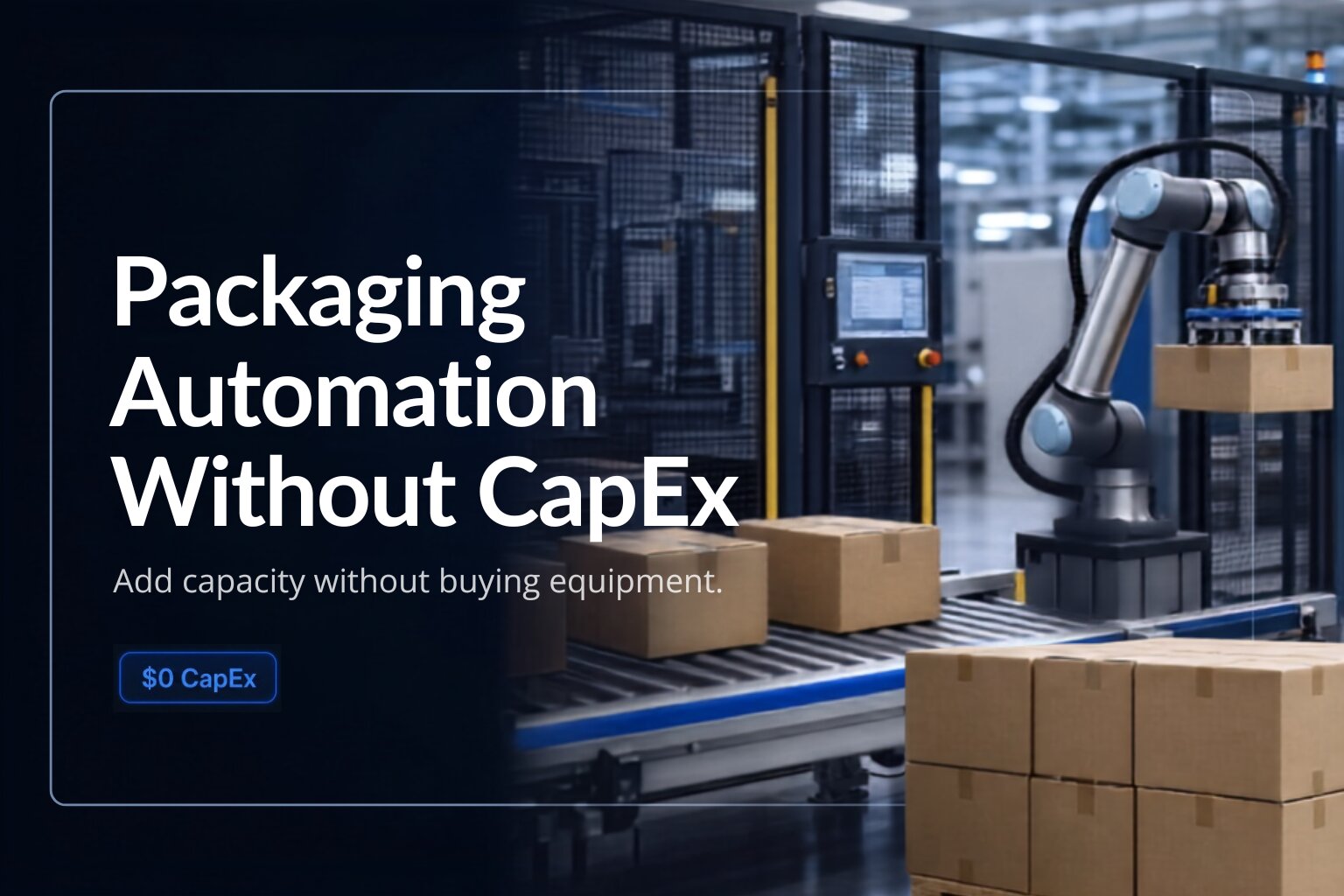
For packaging manufacturers, the question is not whether automation would help. Plant teams know where the pressure is. The harder question is how to increase output without tying up capital, waiting for budget approval, or buying equipment before the line proves the case.
That is where packaging automation without CapEx becomes practical. Instead of treating automation as a machinery purchase, manufacturers can bring in robotic capacity as a service.
For teams dealing with labor gaps, palletizing constraints, or rising demand, that can be the difference between discussing automation and deploying it.
Why CapEx Slows Down Packaging Automation
Traditional automation projects usually begin with a capital request covering the robot, tooling, conveyors, guarding, integration, installation, training, spare parts, and maintenance. By the time the full cost is visible, approval can slow down quickly.
On paper, buying equipment looks straightforward. In the plant, it rarely feels that simple. Operations teams still need to ask:
- Will this line still run the same product mix next year?
- Can maintenance support another automation cell?
- What happens if throughput assumptions are wrong?
- Who owns uptime when the system goes down?
Those are operating questions, not just finance questions. Packaging lines change, SKUs multiply, staffing levels move up and down, and demand does not wait for CapEx approval. That is why more teams are looking at packaging automation solutions that behave more like operating capacity than a machinery purchase.
What No-CapEx Automation Actually Means
No-CapEx automation does not mean automation is free. It means the manufacturer is not buying the equipment upfront. The automation is delivered through a subscription or service model, often referred to as Robotics-as-a-Service.
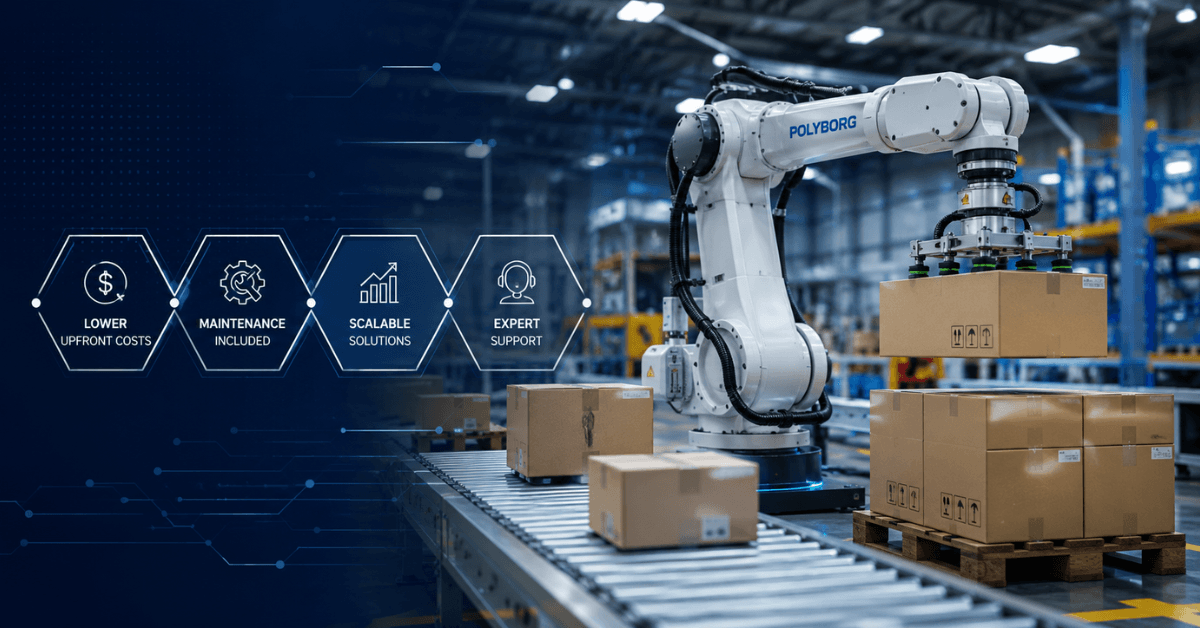
In practical terms, the provider supplies the robotic workcell, deployment support, maintenance, monitoring, and service coverage. The manufacturer pays for automation output rather than owning every part of the system.
For a plant manager or operations director, the value is operational as much as financial. A no-CapEx model can help teams move faster on a known constraint, reduce dependence on manual work, and shift more support responsibility to the provider.
This is one reason automated packaging systems delivered as a service are becoming more attractive for palletizing, case handling, workcells, and end-of-line automation.
Where This Model Fits Best
No-CapEx automation is not the answer for every operation. It fits best when the problem is clear, repetitive, and measurable.
Good candidates include manual palletizing stations, end-of-line areas where finished goods back up, steady case packing tasks, lines where operators are pulled between stations, and co-packers that need more throughput without another shift.
A practical example would be a contract packager running mixed retail cases across two shifts. If supervisors keep moving people from inspection or changeover support to palletize cases, a no-CapEx robotic palletizing cell can stabilize that end-of-line task while keeping skilled workers focused on line performance.
CapEx Purchase vs Subscription Automation
The right model depends on the plant's priorities. Some manufacturers still prefer to buy equipment when products are stable, capital is available, and the in-house team can support the system. Others need flexibility and faster deployment.
| Decision Area | Traditional CapEx Purchase | No-CapEx / Service Model |
|---|---|---|
| Upfront cost | Higher equipment and integration spend | Lower upfront commitment |
| Approval path | Tied to capital budgeting cycles | Easier to evaluate as operating capacity |
| Ownership | Manufacturer owns the system | Provider typically owns or manages the system |
| Maintenance burden | Internal team carries more responsibility | Provider support is usually included |
| Flexibility | Best for stable applications | Better for demand or labor uncertainty |
| Speed | Slower due to budget and procurement | Often faster from evaluation to deployment |
How No-CapEx Automation Adds Capacity
Increasing capacity is not always about running faster. In many packaging plants, output is lost in small ways: a line waits because palletizing is behind, a supervisor moves people around to cover callouts, or operators leave their stations to help at the end of the line.
No-CapEx manufacturing automation solutions can stabilize the parts of the process that should not depend on whether enough people showed up that day. When a robotic workcell takes over a repetitive packaging task, the plant can use people where judgment, inspection, changeover support, and problem-solving matter more.
That is the real gain. It is not only about replacing manual labor. It is about making the line less fragile.
What to Check Before Moving Forward
Before choosing any automation model, the plant should understand the application clearly enough to avoid guessing.
Start with these inputs: cases, units, or pallets per shift; operators assigned to the task; overtime or temporary labor used; changeover frequency and SKU mix; available floor space and nearby constraints; downtime patterns; target output after automation.
A good provider should be able to work from this information and explain whether automation fits, what needs to be validated, and where the risks are. If the discussion moves straight to a robot model without understanding the line, that is usually a warning sign.
When Buying Equipment Still Makes Sense
There are cases where buying equipment is the right call. If the process is stable, volume is predictable, capital is available, and the internal team is comfortable owning the system, a CapEx purchase can make sense.
Buying may also be better when the plant wants full control over engineering standards, modifications, and long-term asset ownership. But if the issue is a recurring output gap, staffing problem, or end-of-line constraint, then a service model is worth a serious look.
For packaging manufacturers evaluating automated packaging systems, robotic palletizing, case handling, or an automated packaging line, the question is no longer only "Should we buy automation?"
A better question is: "What is the fastest, lowest-risk way to make this line more reliable?"
Robotics-as-a-Service may be the right place to start.
Conclusion
Packaging automation without CapEx gives manufacturers another way to increase output without turning every project into a major equipment purchase. It is not just a financing option.
For many operations teams, it is a practical way to move faster, reduce staffing pressure, and get support included from day one.
Book a Packaging Automation Assessment
Review your packaging line with Polyborg AI to compare CapEx and subscription automation options, identify the most practical starting point, and determine whether Robotics-as-a-Service is the right fit for your operation.
FAQ
Frequently asked questions
- What is packaging automation?
- Packaging automation involves using robotic systems, automated packaging equipment, and intelligent software to perform packaging tasks such as case packing, palletizing, labeling, sorting, and end-of-line handling with minimal manual intervention.
- What does packaging automation without CapEx mean?
- It means implementing packaging automation through a subscription or service-based model rather than purchasing equipment upfront, helping manufacturers preserve capital while increasing capacity.
- Is Robotics-as-a-Service the same as leasing equipment?
- Not exactly. Leasing focuses on equipment access, while Robotics-as-a-Service usually includes deployment, monitoring, maintenance, and support.
- Which packaging tasks fit no-CapEx automation best?
- The best fits are repetitive, measurable tasks such as robotic palletizing, case packing, case handling, and end-of-line packaging automation.
- Can no-CapEx automation support an automated packaging line?
- Yes, especially when the line has a clear manual constraint that can be stabilized with a robotic workcell or other automated packaging systems.