
Packaging Automation ROI: 5 End-of-Line Bottlenecks That Reduce Throughput and Increase Costs
Plant managers rarely point to the primary filler when asked where they lose money. They point to the end of the line. This is where products back up, operators fatigue, and throughput collapses.
To calculate accurate packaging automation ROI, operations teams must stop looking at theoretical labor savings and cost out the specific bottlenecks choking their lines.
Why End-of-Line Bottlenecks Matter More Than You Think
Imagine a production line capable of producing 220 cases per minute.
The filler, case packer, and labeling equipment are all capable of maintaining this speed.
However, by the end of the shift, the production report shows an average output of only 185 cases per minute.
Nothing broke. Maintenance logged zero equipment failures. So where did the missing production go?
The answer often lies downstream.
When finished cases cannot leave the line quickly enough, accumulation conveyors fill up. Sensors stop conveyors. Upstream equipment automatically slows down to prevent product damage.
Within minutes, a perfectly functioning production line is operating well below its design capacity.
This is why successful manufacturers focus on removing constraints, not simply installing faster machines.
1. The Friday Afternoon Throughput Collapse
What is the throughput collapse? The throughput collapse refers to the predictable drop in manual packaging line speed toward the end of a shift or week due to operator fatigue.
The Bottleneck: An operator stacking 40 cases per minute on Tuesday will likely drop to 28 by Friday afternoon. This fatigue causes upstream conveyors to back up.
Common Mistake: A frequent error in ROI calculation is comparing a robot's speed directly to a human's peak speed for five minutes. ROI must be calculated against the human's average speed across an entire shift, including fatigue and breaks.
The Cost: A line throttling down by 15% for the last two hours of every shift loses hundreds of hours of productive capacity annually.
The Fix: A robotic palletizer does not tire, stacking cases consistently all week. Replacing the manual bottleneck allows the upstream line to run optimally.
2. Unplanned Overtime and Weekend Premiums
The Bottleneck: When manual lines miss targets due to fatigue or absenteeism, schedules slip. To hit shipping deadlines, managers schedule weekend overtime.
The Cost: Unplanned overtime erodes profitability. Mid-market facilities often spend $75,000 to $100,000 annually on weekend premiums to compensate for weekday inefficiencies.
The Fix: Manufacturing automation services help hit targets during standard hours. Robotic workcells can run lights-out.
3. Ergonomic Injuries and Workers' Compensation Claims
The Bottleneck: End-of-line tasks like case packing and palletizing require repetitive lifting, twisting, and bending. Over time, this takes a physical toll on operators, leading to musculoskeletal disorders (MSDs) and repetitive strain injuries.
The Cost: The average direct cost of a workers' compensation claim for a lifting-related injury is around $40,000, with indirect costs pushing the total financial impact much higher. A single severe injury can wipe out months of margin.
The Fix: Automation removes humans from the most dangerous, ergonomically hazardous tasks on the floor. By deploying a robotic palletizer, facilities eliminate the root cause of lifting injuries.
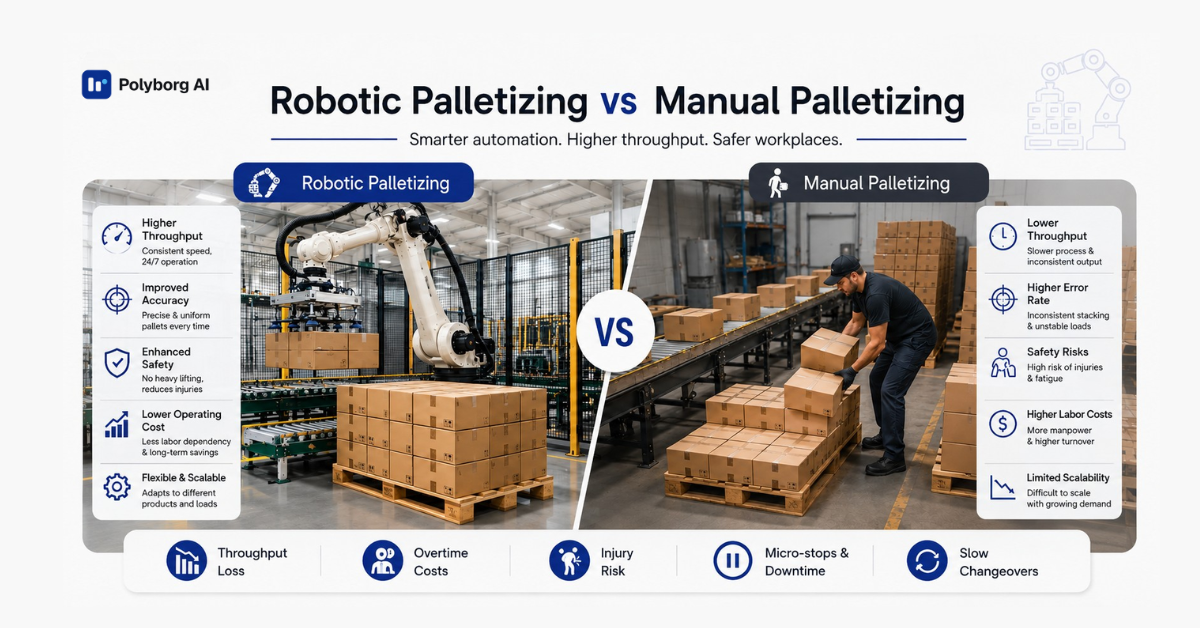
| Metric | Manual End-of-Line | Automated End-of-Line |
|---|---|---|
| Throughput Consistency | Declines over shift | 100% consistent |
| Injury Risk | High (repetitive lifting) | Near zero |
| Overtime Dependency | High (to recover lost volume) | Low (predictable output) |
| Data Visibility | Low (estimated counts) | High (real-time tracking) |
4. The "Ghost" Downtime of Micro-Stops
The Bottleneck: Major breakdowns get all the attention, but "micro-stops," pauses of less than five minutes, are the silent killers of packaging line ROI. These occur when an operator steps away, drops a box, misaligns a label, or takes too long to swap out an empty pallet.
The Cost: Because micro-stops are rarely logged, they act as "ghost" downtime. A three-minute stop occurring ten times a shift results in 30 minutes of lost production daily. In sectors where unplanned downtime costs average $260,000 per hour, these micro-stops are costly.
Practical Example: Consider a line producing $500 of product per minute. If manual palletizing causes the line to pause for just two minutes every hour (to clear a jam or swap a pallet), that is 16 minutes of lost production per shift. Over a year (500 shifts), those micro-stops cost the facility $133,000 in lost output. A robotic system recovers that capacity.
The Fix: Robotic systems eliminate human-induced micro-stops. They do not take unscheduled breaks or drop cases. Modern packaging automation solutions track every second of operation, providing data visibility that exposes and eliminates ghost downtime.
5. High-Mix Changeover Delays
What is a changeover delay? A changeover delay is the downtime incurred when a packaging line stops to reconfigure equipment for a different product size, format, or SKU.
The Bottleneck: In modern packaging, high-mix, low-volume runs are becoming the norm. When switching from a 12-pack case to a 24-pack case, manual operators or traditional mechanical automation systems require time to adjust rails and recalibrate.
The Cost: If a changeover takes 45 minutes and happens twice a shift, the line loses 1.5 hours of productive time every day, limiting the number of SKUs a facility can run.
The Fix: Modern automation uses recipe-driven software for changeovers. Operators can switch SKUs with a few taps on an HMI screen, reducing changeover time from 45 minutes to under five.
Calculating the True ROI of Automation
When calculating packaging automation ROI, do not just look at the hourly wage of the operator being reassigned. Calculate the value of the bottlenecks removed: recovered throughput, overtime reduction, and risk mitigation.
How do I calculate packaging automation ROI? To calculate packaging automation ROI, add direct labor savings, reduction in overtime premiums, savings from avoided injury claims, and margin gained from increased throughput. Divide this total savings by the annualized cost of the automation system.
For a deeper dive into evaluating automation partners, read our guide on How to Evaluate RaaS Automation Providers.
Find the Bottlenecks on Your Floor
Ready to identify the bottlenecks on your floor? Contact Polyborg AI for a site assessment. We will help you build a real-world ROI case.
FAQ
Frequently asked questions
- What is packaging automation ROI?
- Packaging automation ROI measures the financial return generated by automation, including labor savings, increased throughput, reduced downtime, lower overtime costs, fewer injuries, and improved production efficiency.
- Why is the end of the production line often the biggest bottleneck?
- End-of-line processes such as case packing and palletizing rely heavily on manual labor. When these activities slow down, upstream equipment must also slow or stop, reducing the throughput of the entire production line.
- Does packaging automation only benefit high-volume manufacturers?
- No. Manufacturers with high-mix, low-volume production often achieve significant ROI through faster recipe-driven changeovers, improved flexibility, and reduced manual intervention.
- How does Robotics-as-a-Service (RaaS) improve ROI?
- RaaS enables manufacturers to deploy automation through a subscription-based model, reducing upfront capital expenditure while allowing them to realize productivity improvements sooner.