
How Robotic Palletizing Systems Handle Mixed SKU Palletizing
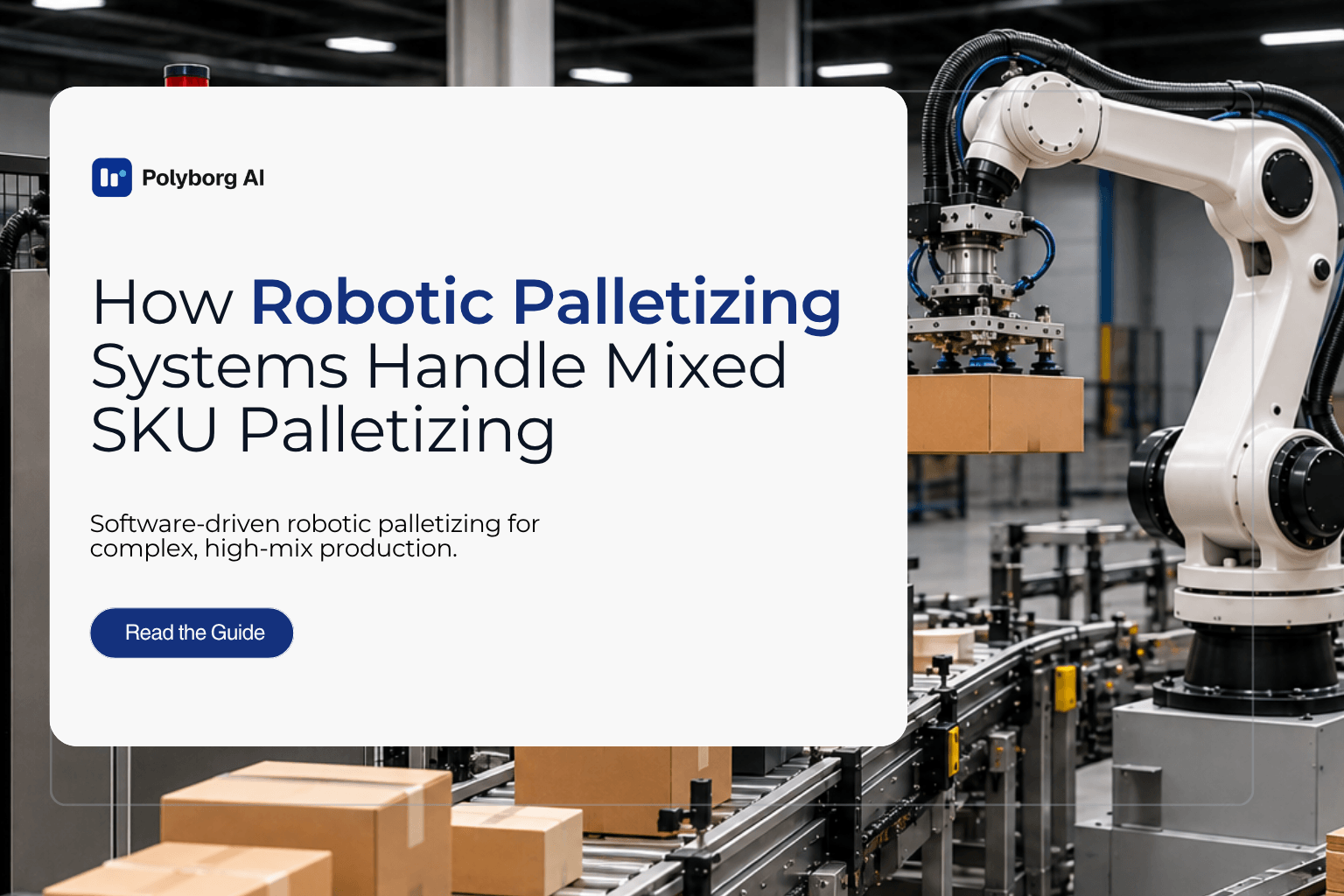
Ask any end-of-line supervisor what the most frustrating part of their shift is, and most will say: the mixed pallet.
It is not the volume; it is the variability. A retailer sends a purchase order requiring a single pallet to carry six different SKUs, each with different dimensions, weights, and fragility. The operator must figure out, in real time, how to stack those cases into a stable, transit-safe load without crushing lighter items.
Retailers now expect store-specific, shelf-ready pallets as standard. The question for operations teams is whether they keep absorbing that complexity manually or let a robotic system handle it.
Historically, automating this process required a sprawling footprint of conveyors and sortation equipment. Today, modern robotic palletizing systems handle mixed-SKU builds within a single, compact workcell.
Key Takeaways
- Mixed SKU palletizing is a major bottleneck in manual operations, causing product damage and high labor turnover.
- Software-driven sequencing acts as a real-time Tetris engine, eliminating the need for operators to guess stacking patterns.
- Adaptive vision and flexible tooling allow a single robotic workcell to handle different case sizes and reflective surfaces without mechanical changes.
- The Robotics-as-a-Service (RaaS) model removes the CapEx barrier, making complex mixed-SKU automation accessible to mid-market manufacturers.
What is Mixed SKU Palletizing?
Mixed SKU palletizing is the process of stacking multiple different Stock Keeping Units (SKUs) - often varying in size, shape, and weight - onto a single pallet. Unlike uniform pallets, which contain identical products, mixed pallets are custom-built to meet specific retailer or distribution center orders, enabling "shelf-ready" deliveries that reduce unpacking labor at the destination.
Why Mixed SKU Pallets Are Becoming the New Standard
Several supply chain trends are driving demand for mixed-SKU palletizing:
- Retailers prefer store-specific deliveries.
- E-commerce fulfillment requires smaller, more frequent orders.
- Manufacturers produce shorter production runs with more product variations.
- Distribution centers want shelf-ready pallets that reduce manual sorting.
- Promotional campaigns require customized product combinations.
As product variety continues to grow, manufacturers need palletizing systems that can adapt quickly without sacrificing speed or consistency.
The Operational Cost of Manual Mixed Palletizing
Building a mixed-SKU pallet by hand is a complex sequencing puzzle. Operators must constantly evaluate the size, weight, and crushability of incoming cases to build a stable load.
This manual puzzle creates immediate bottlenecks. First, throughput collapses. While an operator might stack a single-SKU pallet predictably, multiple case sizes force them to pause, assess the mix, and decide where cases belong.
Second, product damage spikes. In a rush to clear a backlog, operators make poor stacking decisions. Heavy cases crush fragile ones, leading to damaged goods and costly chargebacks.
Finally, the process accelerates labor burnout. Palletizing is already the most physically demanding job on the line. According to OSHA, manual material handling accounts for hundreds of thousands of workplace injuries annually, with direct costs for a single back injury ranging from $40,000 to $80,000. Adding the cognitive load of mixed-SKU sequencing increases fatigue, driving higher turnover.
How Modern Robotics Solve the Mixed-SKU Puzzle
The transition from manual labor to automation used to mean trading flexibility for speed. Early automated palletizers were rigid - running one case size at high speed but requiring hours of reprogramming to switch formats.
Today, the intelligence has moved from mechanical hardware to the software layer, allowing a single robotic workcell to handle unpredictable, high-mix environments dynamically.
Software-Driven Pallet Sequencing
The core challenge of mixed palletizing is knowing what to put where. Modern systems solve this using advanced software that acts as a real-time Tetris engine.
Instead of relying on an operator to guess the best pattern, the software calculates the optimal pallet build on the fly. It analyzes dimensions, weights, and fragility rules for every SKU. The software then directs the robot to place heavier cases at the base and lighter items at the top, ensuring stability.
Adaptive Vision and Handling
In a mixed-SKU environment, cases arrive in different sizes, shapes, and orientations. Traditional automation struggles when a box is not exactly where it is expected to be.
Common Mistake: A frequent error is assuming that any vision system can handle mixed SKUs. Standard vision struggles with reflective tape or slightly skewed boxes. True adaptive vision is required to calculate coordinates in milliseconds without stopping the line.
Modern manufacturing automation services use adaptive vision - camera-based machine vision systems that recognize object orientation in real time - to overcome this. The vision system identifies the incoming case, confirms its orientation, and relays that data to the robot in milliseconds.
The robot's End-of-Arm Tooling (EOAT) is adaptive. This allows it to securely grip a heavy master case on one cycle and gently handle a smaller display carton on the next, without a tool change.
Manual vs Robotic Mixed SKU Palletizing
| Manual Palletizing | Robotic Palletizing |
|---|---|
| Operator decides stacking sequence | Software calculates every placement |
| Quality varies between shifts | Consistent pallet quality |
| Higher risk of damaged products | Optimized load stability |
| Dependent on operator experience | Repeatable automated process |
| Difficult during labor shortages | Continuous operation with minimal intervention |
| Frequent decision-making slows production | Automatic optimization during every cycle |
The Financial Argument for Automating Mixed Pallets
Designing a custom, highly complex mixed-SKU system traditionally required a massive upfront capital expenditure (CapEx) and months of disruptive integration.
This is why the Robotics-as-a-Service (RaaS) model - where manufacturers pay a monthly fee rather than buying equipment - is preferred. With RaaS, manufacturers subscribe to the outcome. The provider handles integration, software programming, and ongoing maintenance.
Our Automated Palletizer Cost Breakdown guide compares the realities of purchasing, leasing, and subscribing to automation.
Questions to Ask Before Investing in a Mixed SKU Palletizer
Not every palletizing system offers the same level of flexibility. Before selecting a solution, manufacturers should ask:
- How many SKU variations can the system manage?
- Can new products be added without extensive programming?
- How are fragile products protected?
- Does the system automatically optimize pallet patterns?
- Can it recover from misplaced cartons without stopping production?
- How does it integrate with existing packaging equipment?
- What reporting and production data are available?
These questions help ensure the system can support future production requirements - not just today's operations.
Setting Up for Success: Signs Your Factory is Ready
Integrating these systems requires planning. You must account for upstream conveyor flow, safety zoning, and operator interaction. Our guide on How to Integrate Automated Palletizer Systems Into Existing Packaging Lines covers what plant teams need to prepare before a robot hits the floor.
Practical Example: Consider a facility shipping 500 mixed pallets a week. If poor manual stacking causes a 2% retailer rejection rate due to crushed bottom cases, that is 10 pallets returned weekly. At an average value of $2,000 per pallet, the facility loses $20,000 a week - or over $1 million annually - just in preventable damage and rework. A robotic system eliminates this cost entirely by calculating optimal load distribution.
Ready to automate mixed-SKU lines without CapEx risk? Contact Polyborg AI to see how our software-driven robotic palletizers handle complex pallet builds.
FAQ
Frequently asked questions
- How do robotic palletizing systems handle mixed SKU palletizing?
- Robotic palletizing systems use intelligent software, machine vision, and adaptive end-of-arm tooling to identify each product, calculate the optimal stacking sequence, and build stable mixed pallets automatically. The system continuously adjusts its stacking pattern based on the products arriving on the conveyor.
- Can one robotic palletizer handle different box sizes and weights?
- Yes. Modern robotic palletizers are designed to handle a wide range of carton sizes, weights, and packaging formats. Using adaptive grippers and intelligent software, a single robotic workcell can palletize different products without manual tool changes or lengthy reprogramming.
- What industries benefit most from mixed SKU robotic palletizing?
- Mixed SKU robotic palletizing is widely used in industries such as food and beverage, consumer packaged goods (CPG), pharmaceuticals, nutraceuticals, personal care, household products, and e-commerce fulfillment, where multiple product types are frequently shipped together.
- What causes pallet instability?
- Pallet instability is primarily caused by poor stacking patterns, like placing heavy items on top of crushable cartons. In manual operations, fatigue and high throughput demands lead operators to make rushed stacking decisions, shifting the center of gravity and causing the load to collapse.
- How do adaptive vision systems work?
- Adaptive vision systems use high-resolution cameras and AI-driven image processing to identify products as they arrive on a conveyor. Unlike traditional systems that require boxes to be in exact, fixed positions, adaptive vision can recognize variations in orientation, shape, and reflective surfaces. It calculates the exact coordinates and sends them to the robotic arm in milliseconds, allowing the robot to adjust its grip dynamically without pausing the line.
- What should manufacturers consider before investing in a robotic palletizer?
- Manufacturers should evaluate production volume, SKU variety, available floor space, existing conveyor systems, pallet configurations, integration requirements, safety standards, maintenance support, and long-term scalability. Selecting a solution that can adapt to future product changes is just as important as meeting current production needs.